
The Story Behind the Sutras: Patanjali Gathers the Threads
There’s a mythic story about how Patanjali came to offer the Yoga Sutras, and like many old stories, it’s less about literal history and more about pointing to the deeper purpose behind the teachings. The legend says that long ago, the ancient sages were overwhelmed by the mental and emotional suffering they saw in themselves and their communities, so they turned to Lord Vishnu for guidance. In response, Vishnu sent them Adishésha—his serpent symbol of awareness and support—who agreed to take human form to help bring clarity to the world.
Adishésha was then born as Patanjali. One version of the story describes a yogini named Gonika praying with her hands cupped together in offering when a tiny being—Adishésha himself—fell into her palms. From this, he became known as “Patanjali,” the one who “fell into folded hands.”
Rather than creating something entirely new, Patanjali’s purpose was to gather and organize the scattered threads of yogic wisdom that already existed—from the Upanishads to oral teachings passed through generations—and weave them into a coherent system. This is how the Yoga Sutras came to be: a concise, intentional stitching together of practices meant to help humans understand the mind and find steadiness.
One last story says that Patanjali gathered a thousand students to teach the Sutras, speaking from behind a curtain so the focus stayed on the transmission itself rather than the personality of the teacher. Whether or not that really happened isn’t the point—the heart of the myth is that these teachings were meant to be timeless, accessible, and a source of clarity for anyone seeking a more liberated way of living.
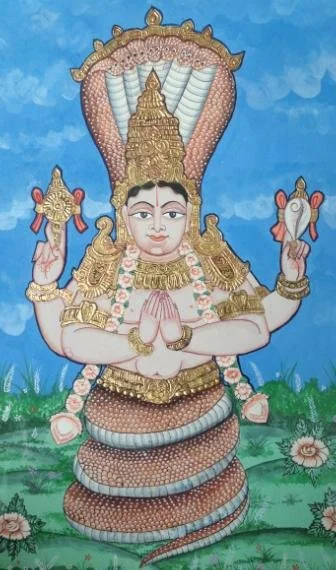
The sage Patanjali depicted as serpentine avatar Shesha.